The Master and Margarita
Mar 6, 2025
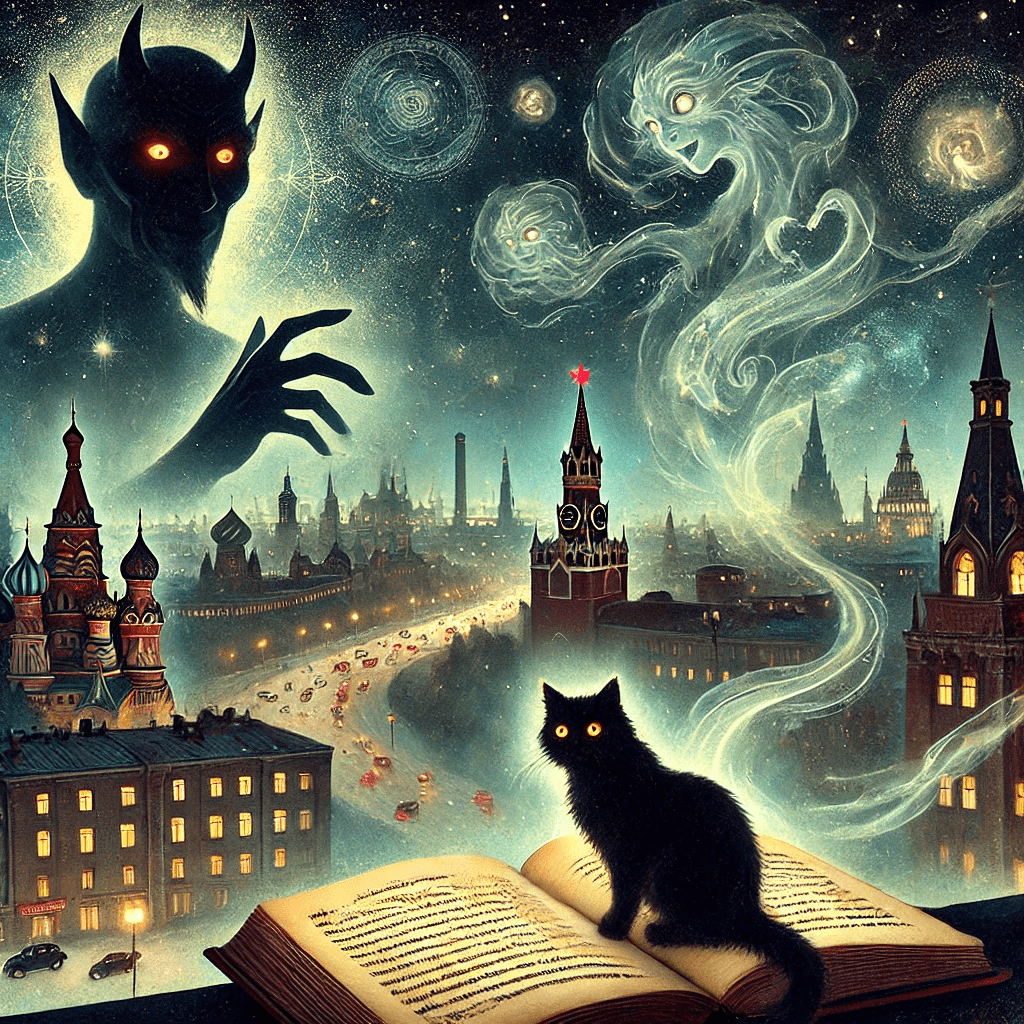
I recently finished Mikhail Bulgakov's The Master and Margarita, a novel written amidst the Stalinist repression in 1930s soviet Russia, only published posthumously in 1966. (1) The satire weaves together three different storylines: the devil’s arrival in Moscow, the tragic love affair between the master and Margarita and the role of Judea’s fifth procurator, Postus Pilate, in the trial of Yeshua Ha-Nozri, otherwise known as Jesus Christ. The story serves as a pointed critique of soviet era bureaucracy, atheism, and conformity while celebrating artistic integrity and individual expression.
What spoke to me the most in reading this book was a calling of attention to the strange and unseen. In the novel’s historical context, this emphasis acts as a commentary on the atheistic nature of the soviet union, but when read in modern times, to me at least, this element of the story takes on new meaning. There has been a new religious movement on the rise since the dawn of the 20th century. The church of Technology has gained numerous followers around the globe who believe in its transformative power to create heaven on earth, and with good reason. Our technological prowess has raised living standards dramatically around the globe and continues to solve long-standing human struggles in domains such as health, communication, and organisation. But in our reverence for innovation, are we perhaps ignoring the unseen aspects of living?
I don’t necessarily mean this in the sense that there is some kind of magical or spiritual dimension which goes unnoticed, although that is certainly an interpretation of what I’m trying to express, but more generally, that, in a world where our god is made manifest in technology, which we increasingly expect to cure all our earthly woes, are we losing our relationship with ourselves? I believe the deterioration of individual self-awareness and introspection is evident in the mental health crisis, which has continued to intensify over the past decade, particularly among the young. Recent studies have shown a 52% increase in depression in adolescents and a 63%% increase in young adults. (2) Furthermore, despite the promise of innovation within the domain of communication, globally, individuals have never seemed to feel so lonely, with a paper from 2021 revealing that 36% of Americans report feeling serious loneliness. (3) This, of course, is not proof that a religious belief in technology causes these psychological shifts, but this commentary doesn’t aim to provide proof of any sort, only postulation, or food for thought rather.
Despite zealous belief in our artificial god’s capabilities, there seems to be an increasing risk that our technological idol is not a god at all but instead a Professor Woland in disguise, the devil himself with an entourage in tow, setting out to savagely remind us of what we may have forgotten. But will we remember, or simply offer further devotion at the altar of human ‘progress’?
1. Bulgakov, M. (1997). The master and Margarita (R. Pevear & L. Volokhonsky, Trans.). Penguin Classics.
2. American Psychological Association. (2019). Mental health issues increased significantly in young adults over last decade. https://www.apa.org/news/press/releases/2019/03/mental-health-adults.
3. Weissbourd, R., Batanova, M., Lovison, V., & Torres, E. (2021). Loneliness in America: How the pandemic has deepened an epidemic of loneliness and what we can do about it. Harvard Graduate School of Education. https://mcc.gse.harvard.edu/reports/loneliness-in-america.
(Photo credit @DALL-E 2025)